.png)


Crawlspace Encapsulation in Downers Grove & the Western Suburbs
An unencapsulated crawl space is a humidity source, energy drain, and pest pathway built into the structure of your home. We fix that permanently.
Family-Owned Since 1990
Transparent & Affordable Pricing
Free Basement Inspections
5-Star Rated Locally

Get Your Free Crawlspace Assessment
Most homeowners never think about their crawl space — until they notice a musty smell on the first floor, see mold on the floor joists above, or find their HVAC system struggling to keep up. An open crawl space in a western-suburb home connects your living environment to the soil below it, pulling in ground moisture, cold air, and whatever the soil introduces. Encapsulation seals that connection permanently with a heavy-duty vapor barrier, conditioned air, and drainage that prevents ground moisture from reaching your home's structure. Encapsulation also eliminates the primary moisture source responsible for floor joist mold in crawl space homes — and in a climate with hot humid summers and cold winters, the air quality and energy gains compound year-round.
15–25%
reduction in whole-home energy consumption after crawl space encapsulation
U.S. Department of Energy & Oak Ridge National Laboratory
The Stack Effect: Why Your Crawl Space Affects Your Whole Home
Air in your home moves upward and escapes through the attic. That escaping air draws replacement air from below — from the crawl space. In an unencapsulated crawl space, that replacement air carries ground moisture, mold spores, radon, and soil gases directly into your living space. You breathe crawl space air every day. Encapsulation interrupts this cycle at the source.
What Crawlspace Encapsulation Includes
Heavy-Duty Vapor Barrier
We install a 12- to 20-mil reinforced polyethylene vapor barrier across the entire crawl space floor and up the foundation walls, sealed at all seams and penetrations. This barrier physically separates your home's structure from ground moisture. It does not tear, sag, or degrade in the crawl space environment. We do not use lightweight 6-mil film — the standard in encapsulation is a barrier rated for decades of service.
Foundation Wall Insulation
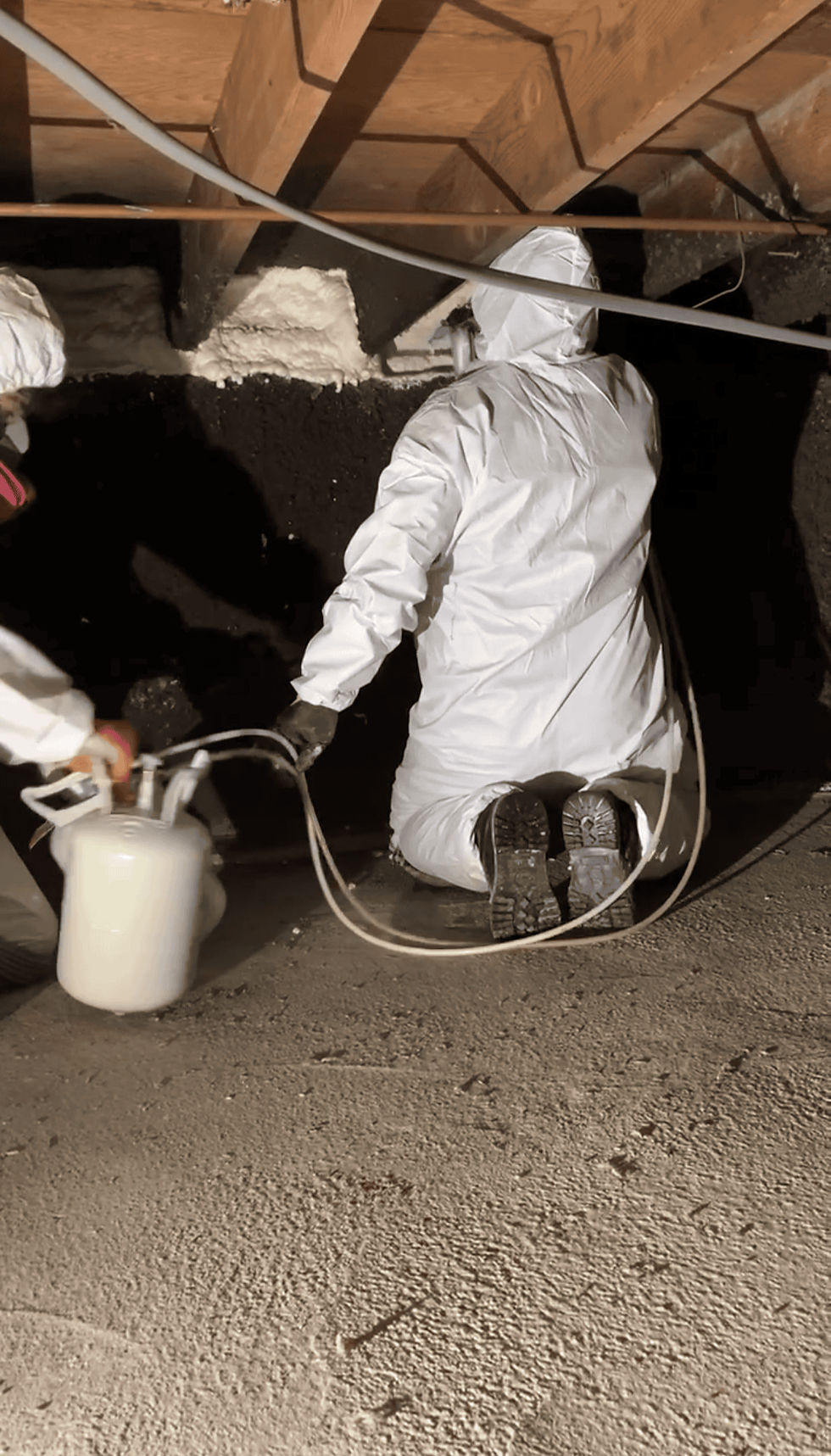
In an encapsulated system, the crawl space is treated as a semi-conditioned space. Rigid foam board or spray foam is applied to the interior of the foundation walls, preventing the concrete from acting as a cold surface that induces condensation inside the encapsulated space. Wall insulation also significantly improves floor temperatures on the level above in our winters.
Vent Sealing
Traditional crawl space design called for perimeter foundation vents to allow outside air to dry the space. Building science research has demonstrated that in humid climates these vents introduce more moisture than they remove — particularly during our humid summers, when warm, humid outdoor air enters a cool crawl space and condenses on every cold surface. We permanently seal all perimeter vents as part of the encapsulation system.
Drainage System
If your crawl space has a history of standing water or significant seepage, we install an interior drainage system and sump below the vapor barrier before encapsulation. A dry crawl space is a prerequisite for an effective encapsulation — vapor barriers cannot hold back hydrostatic water intrusion.
Dehumidifier
A sealed crawl space is a closed environment. Even with a vapor barrier and sealed vents, residual moisture from the soil, air infiltration at penetrations, and normal material off-gassing accumulates over time. A purpose-built crawl space dehumidifier maintains safe relative humidity levels year-round without the energy penalty of a portable consumer unit running in an uncontrolled space.
Our Encapsulation Process
Assessment: We inspect the crawl space for standing water, active seepage, mold on framing, pest activity, and existing insulation or vapor barrier condition.
Preparation: Old vapor barrier, debris, and compromised insulation are removed. Any drainage needs are addressed before barrier installation.
Vapor barrier installation: Heavy-duty barrier is installed across the floor and up the walls, overlapped and sealed at all seams.
Vent sealing and wall insulation: Foundation vents are sealed; rigid foam is installed on the interior wall surface.
Dehumidifier installation: Unit is placed, wired, and set for optimal performance. We walk you through maintenance — typically annual filter cleaning.
What Neighbors Say
★★★★★ 5-star rated across the western suburbs
★★★★★
Connor & his men did a fantastic job in my crawlspace. From providing an estimate through completing the work, they went out of their way to help me solve my issues. The job was done quickly and cleanly taking care with furniture and flooring that needed to be moved and covered to complete the work. If you want an honest assessment of your needs and a fair price, call Accu Dry!
— Dawn Jelinek, Google review, 2025.07.29
★★★★★
Crawlspace encapsulation — looks great. The crew was very professional, well trained, and courteous. Thank you.
— Ed A, Google review, 2025.05.22
★★★★★
Showed up on time. Excellent communications. Went above and beyond by shop-vacuuming the water out of the crawl space. Did the work exactly as discussed.
— Joseph Schultz , Google review, 2025.06.11
Why Accu-Dry
We do not cut corners on barrier thickness. We install 12-mil minimum barrier material. Thin film fails within years in a crawl space environment. Proper encapsulation uses heavy-duty material rated for decades.
Drainage before encapsulation, always. We do not seal a wet crawl space. If drainage is needed, we solve that first — the right way.
Lifetime transferable warranty. Our encapsulation systems are warranted for the life of the home and transfer to new owners.
35+ years in local crawl spaces. We understand what Illinois winters and humid summers do to unprotected crawl spaces, and we build systems that hold up to both. We are 5-star rated and BBB-accredited.

Serving the western suburbs
Downers Grove · Westmont · Naperville · Hinsdale · Lisle · Woodridge · Clarendon Hills · Lombard · Wheaton · Glen Ellyn
Frequently Asked Questions
How much does crawlspace encapsulation cost in the area?
Most crawl space encapsulation projects in the western suburbs range from $5,000 to $15,000 depending on crawl space square footage, height, moisture conditions, and whether drainage or a dehumidifier is included. We provide a written estimate after every free assessment — broken down by component so you understand exactly what you are getting.
How long does encapsulation take?
Most crawl space encapsulation projects take one to two days. Larger crawl spaces with drainage installation may take three days. We access the crawl space from exterior access doors or a floor hatch and minimize disruption to the occupied areas of your home.
Do I need a dehumidifier with encapsulation?
In our climate, yes — we recommend it strongly. Illinois summers routinely see outdoor relative humidity above 80%. Even a well-sealed crawl space accumulates moisture from residual soil evaporation, air infiltration at plumbing and HVAC penetrations, and normal diffusion through the barrier material. A properly sized dehumidifier maintains the space below 55% relative humidity, which is the threshold below which mold cannot grow.
What is the difference between a vapor barrier and full encapsulation?
A vapor barrier is just the ground cover — typically 6-mil polyethylene installed loosely on the crawl space floor. Full encapsulation includes a heavy-duty barrier sealed at all seams and penetrations, wall coverage, sealed vents, wall insulation, and climate control. A vapor barrier alone addresses only a fraction of what encapsulation solves and degrades much faster. We install full encapsulation systems — not vapor barriers.
Can I use my crawl space for storage after encapsulation?
Yes. An encapsulated crawl space is a clean, dry, controlled environment. Many homeowners use it for HVAC equipment, holiday storage, and mechanicals. We install barrier material rated for light foot traffic and equipment access.