.png)


Foundation cracks are common in western-suburb homes. Illinois clay soil shrinks in summer, expands in wet seasons, and freezes and thaws repeatedly each winter — putting repeated lateral stress on foundation walls that no building material fully resists. What matters is not just whether a crack exists, but what type it is, how it has moved, and whether water is finding its way through. Accu-Dry has diagnosed and repaired foundation cracks across Downers Grove and the western suburbs for more than 35 years. Northeast Illinois sits on expansive glacial clay with some of the highest shrink-swell potential in the Midwest — soil that is rarely dry for long, and that expands and contracts with every season.
37 inches
average annual precipitation in northeast Illinois
Illinois State Climatologist Office, University of Illinois
What Kind of Crack Do You Have?
Crack shape and direction tell us a great deal before we pick up a tool.
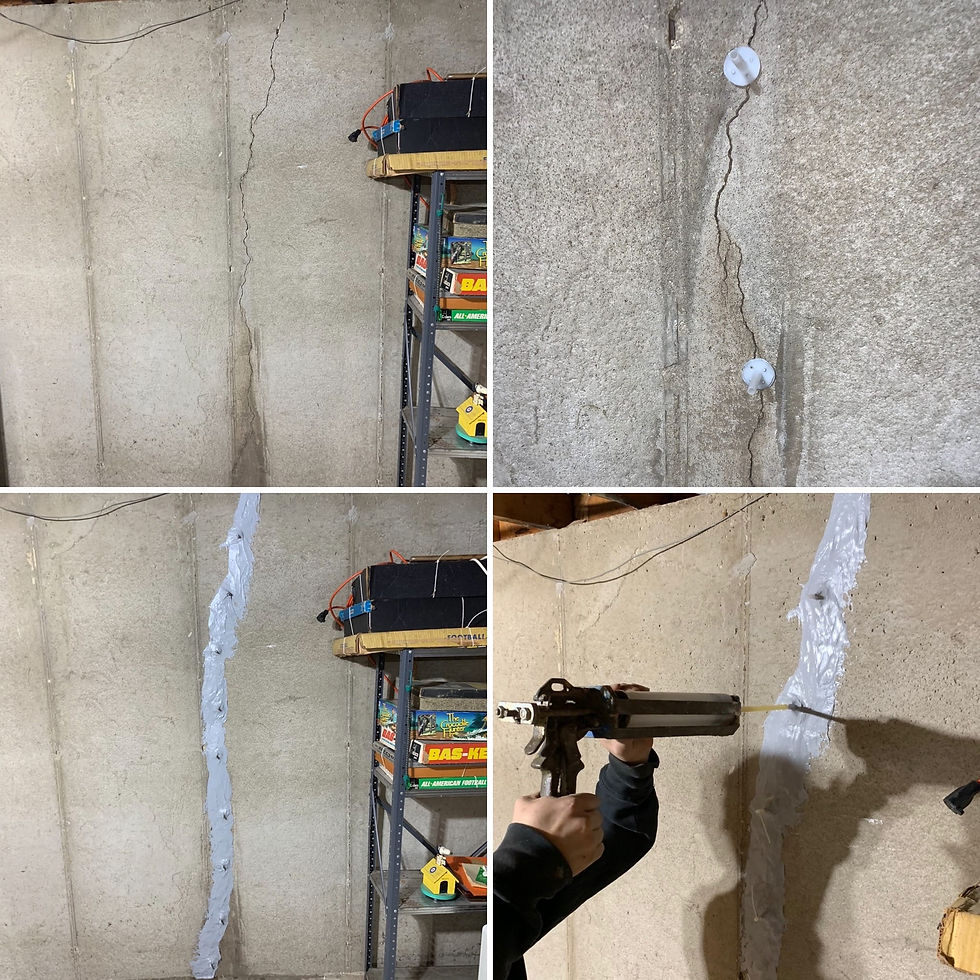
Vertical cracks — Most common. Usually caused by concrete curing and minor settlement. Often sealed with polyurethane or epoxy injection. Typically not structural unless wide or with displacement.
Horizontal cracks — A structural warning sign. Indicate soil or hydrostatic pressure pushing inward on the wall. Require prompt evaluation — carbon fiber straps or wall anchors are often needed.
Diagonal or stair-step cracks — Common in block foundations. Indicate differential settlement or corner stress. Severity ranges widely and must be assessed in person.
Corner cracks — Appear where two walls meet. Typically tied to settlement or drainage-related movement.
Floor cracks — Caused by settlement below the slab or upward hydrostatic pressure. May allow water infiltration through the slab.
Repair Methods We Use
Polyurethane Injection
Our go-to for active water-leaking cracks. Polyurethane expands to fill every void in the crack, bonds to both wet and dry concrete, and cures as a flexible, permanent waterproof seal. It works on hairline cracks and on cracks up to one-quarter inch wide. No excavation. Most repairs are completed in a single visit. Backed by a lifetime no-re-leak warranty.
Epoxy Injection
Used when the goal is structural bonding rather than waterproofing. Epoxy cures harder than concrete — the ideal choice when a dry crack needs its structural integrity restored. Not suitable for cracks where water is actively weeping, since moisture prevents full adhesion.
Carbon Fiber Straps
For horizontal cracks or walls with inward bow of less than one inch. High-strength carbon fiber straps are bonded to the interior wall surface, arresting further movement and stabilizing the structure permanently. No excavation. No disruption to landscaping or exterior grade. Covered by a lifetime warranty against further bowing.
Wall Anchors
When wall deflection is too severe for carbon fiber to address alone, steel wall anchors provide the solution. Interior plates are connected by a steel rod driven through the foundation into stable exterior soil. Once installed, anchors can be periodically tightened — gradually returning a bowed wall toward plumb over time.

Our Diagnosis and Repair Process
Free inspection: We examine all visible cracks, measure width and displacement, probe for moisture, and assess exterior drainage conditions.
Written diagnosis: You receive a clear explanation of what caused each crack, the specific repair we recommend, and a written, itemized estimate.
Repair: Our own crew performs the work. Most injection repairs are completed in a single visit. Carbon fiber and anchor projects typically take one day.
Warranty documentation: We provide written warranty details before we leave and answer every question about long-term care.
What Neighbors Say
★★★★★ 5-star rated across the western suburbs
★★★★★
Had a foundation crack fixed. Very easy to work with and came out just a couple days later! Margaret was so sweet, Conor knew exactly what to look for when he came out for estimate and Israel did a great job repairing. Would highly recommend!
— Emily Farns, Google review, 2026.05.26
★★★★★
Justin and Israel were wonderful to deal with and had patience in explaining what they needed to do for my foundation cracks. Margaret was phenomenal customer service as well- would highly recommend this company!
— Cynthia McGann, Google review, 2026.03.31
★★★★★
More than six years ago, Accu-Dry repaired cracks in my foundation and provided a lifetime transferable warranty. Recently, when I needed a copy of the original receipt, they were able to retrieve and provide it without any issues—even after all these years. Margaret and the entire team were professional, responsive, and truly committed to excellent customer service.
— Leticia Flores Lima, Google review, 2026.03.21
Why Accu-Dry
Accurate diagnosis before any work begins. We identify the cause before recommending a method. The wrong repair for the wrong crack fails — and costs you twice.
Structural and waterproofing expertise in one call. We handle both foundation repair and water infiltration. You do not need two separate contractors.
35+ years on local foundations. We understand what Illinois clay and Midwest winters do to basement walls across more than three decades of seasons.
5-star rated & BBB-accredited. Consistent 5-star reviews and an accredited Better Business Bureau rating, earned across the western suburbs.
Lifetime no-re-leak warranty on injection repairs. Polyurethane and epoxy injection repairs are backed for the life of your home against re-leaking at the treated crack.
Serving the western suburbs
Downers Grove · Westmont · Naperville · Hinsdale · Lisle · Woodridge · Clarendon Hills · Lombard · Wheaton · Glen Ellyn
Frequently Asked Questions
How do I know if my foundation crack is serious?
Horizontal cracks and cracks with displacement — where one side has shifted higher or inward relative to the other — are the most urgent. Cracks that are actively widening, leaking water, or exceed one-quarter inch in width also warrant prompt professional evaluation. Vertical shrinkage cracks under one-quarter inch with no water are common in poured concrete walls in our area and are usually less critical — but they should still be sealed before they allow water entry. When in doubt, call us for a free look.
Can foundation cracks be repaired from the inside?
Yes. Polyurethane and epoxy injection both work from the interior with no excavation. Interior repair is effective for the large majority of residential foundation cracks in the area, including most vertical and diagonal cracks in poured concrete walls.
Will a repaired crack come back?
A correctly diagnosed and properly repaired crack should not re-leak. Our injection repairs are covered by a lifetime warranty against re-leaking. If underlying pressure issues are severe, new cracks may eventually form in different locations — which is why we also assess drainage, grading, and hydrostatic conditions during every inspection.
What does foundation crack repair cost?
Single-crack polyurethane injection repairs typically range from $500 to $1,500 depending on crack length and access. Carbon fiber strap projects are priced by wall length. We provide a written estimate after every free inspection.
Should I repair a foundation crack before selling my home?
Yes — for practical and legal reasons. Illinois requires sellers to disclose known foundation defects. An unrepaired crack flagged by a buyer's inspector creates negotiating leverage against you and can delay or kill a sale. A professionally repaired crack backed by a lifetime transferable warranty is a documented, warrantied fix that transfers to the buyer — a meaningfully stronger position. Most injection repairs are completed in a single visit and cost a fraction of what a buyer will demand in concessions if they spot an open crack.